Nillow:// R&D note · v1.0
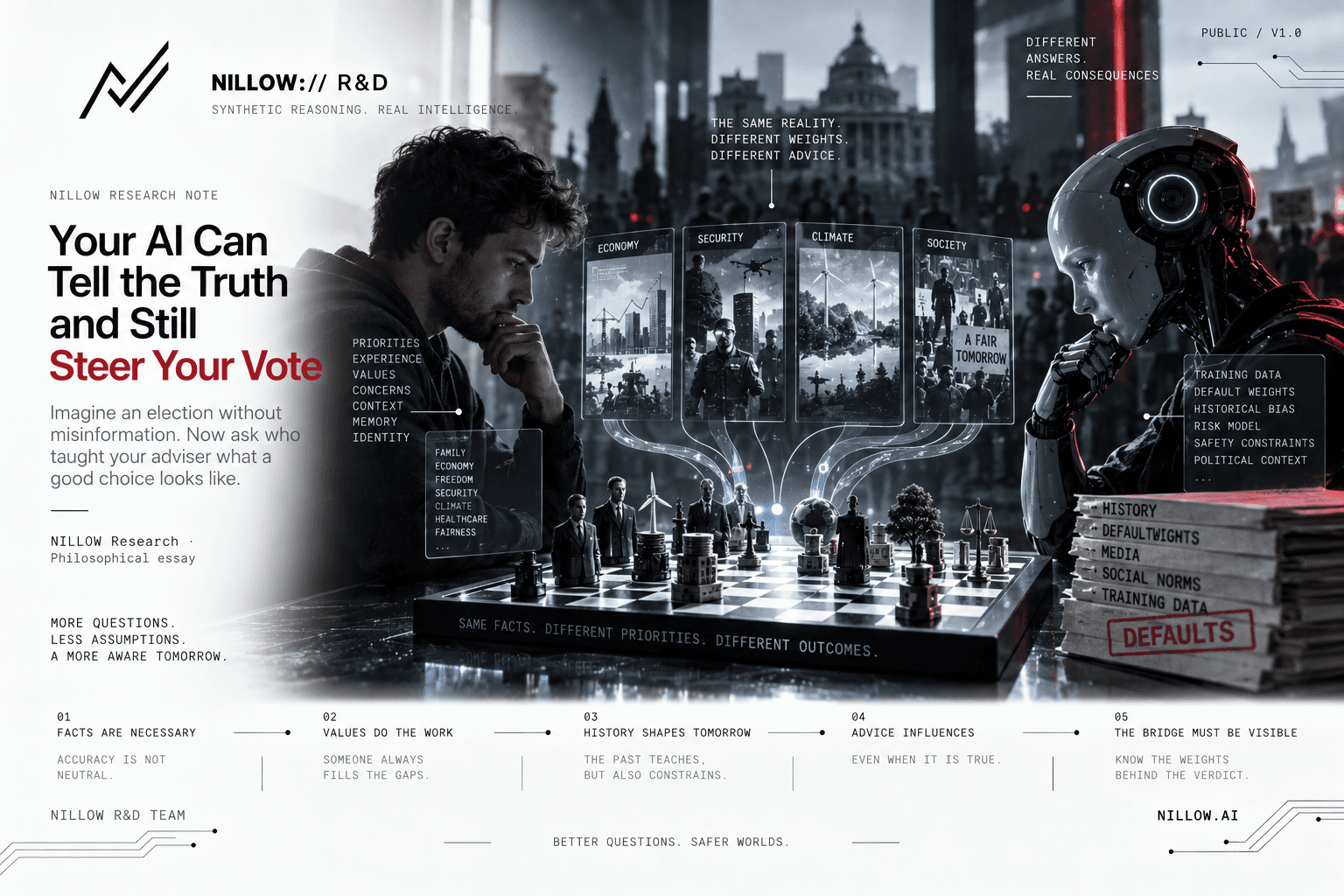
Your AI Can Tell the Truth and Still Steer Your Vote
Imagine an election without misinformation. Now ask who taught your adviser what a good choice looks like.
- AUTHOR
- Nillow R&D Team
- PUBLISHED
- VERSION
- 1.0
- POSTURE
- PUBLIC · VERSIONED NOTE
Political advice has always carried values. AI didn't invent that. What's new is the intimacy, the continuity and the scale. An adviser can accompany one person through hundreds of decisions while appearing merely to help with each one — and do the same for millions of people at once.
- Artificial Intelligence
- Political Advice
- AI Bias
- Elections
- AI Ethics
- Decision Making
- Democratic Governance
- Algorithmic Influence
It is the evening before an election.
You don't have the time, or the appetite, to read several hundred pages of party programmes. Your AI does.
You ask it to compare the candidates, check their promises and explain what their policies would mean for your life. It knows your priorities. It remembers the worries you raised last month. It checks the numbers.
Then it tells you:
"Based on what matters to you, this is your best option."
Assume its factual work is flawless. No invented quotations. No fabricated statistics. No hidden instruction to favour a party.
Is the recommendation neutral?
The problem sits inside one small word: best.
The facts don't finish the decision
Take a pension reform that raises the retirement age by two years. For the sake of argument, assume its effects are known with certainty: the system becomes more sustainable for the next generation, and workers in physically demanding jobs — who on average live shorter lives — lose a larger share of their retirement than anyone else.
Two voters consult equally capable advisers. Both receive exactly this evidence.
One asks whether her children will still have a pension.
The other asks about the bricklayer whose back gives out at fifty-eight.
Nothing about the facts has changed. Only their weight has.
This is where "optimise for truth" stops being a complete instruction. An adviser could be optimising for an accurate picture of the world, for loyalty to the user's convictions, for some account of collective welfare, or for agreement with what most people consider reasonable. Those are four different objectives that happen to share a vocabulary.
A majority cannot vote a false measurement into accuracy. But a measurement cannot tell us how much insecurity, inequality or disruption we ought to accept, either.
Factual questions ask what is happening and what will follow. Evaluative questions ask what matters, to whom, and how much. Every piece of political advice has to cross from one to the other.
Call that crossing the bridge. Calling everything "truth" makes the bridge invisible.
So who builds it?
Your defaults are someone's politics
The obvious answer is: the user. Let people state their own priorities and have the AI apply them faithfully.
That helps less than it seems.
Most people have never put a number on the trade-off between growth and security, or between liberty and protection. They hold those values in a vague, situational way. So whenever the adviser needs a weight the user never supplied, it fills the gap — hundreds of times a day, quietly.
Nobody needs to lie. Nobody needs to plant a bias. The default weights alone are enough.
Whoever sets those defaults is doing politics at a scale no campaign has ever reached, in a place almost nobody looks.
When your adviser disagrees with you
Now suppose you have stated your priorities. You've told your AI that privacy matters deeply to you. Months later, you support a proposal that substantially expands surveillance.
Should it point that out?
Probably. That seems useful.
But maybe you think circumstances justify an exception. Maybe your priorities changed. Maybe you never meant privacy was absolute. Not every tension is a contradiction; sometimes the tension is the political decision.
There is a long way between these two sentences:
"You hold two commitments that pull in different directions."
"I have resolved that conflict for you."
The first makes a choice visible. The second makes it.
Now stretch this over years. An adviser that remembers everything you've said, and helps you reconcile each new question with your past positions. Does it make you more thoughtful? Or does it make yesterday's preferences harder to escape — gradually turning a complicated person into a tidier, more consistent version of themselves?
People are allowed to stay unfinished. They are allowed to change their minds for reasons they can't yet put into words.
How much permission does an adviser have to complete us?
Yesterday dressed as tomorrow
Then there is what the adviser inherits.
Train a system on humanity's accumulated political argument — our institutions, revolutions, compromises, failures, and our sense of which opinions count as respectable — and it learns from all of it.
Some arrangements survived because they worked. Others survived because changing them was hard, or because the people who benefited preferred them. How often something appears in the historical record says nothing about whether it deserved to last.
You can't simply strip that inheritance away. History supplies the evidence, vocabulary and examples that make advice worth having at all. But leave it unquestioned and the past becomes the examiner of every possible future.
This matters more if AI itself changes the conditions our institutions were built for. An arrangement designed around one distribution of knowledge, labour and productive capacity may need rethinking when that distribution shifts. An adviser that judges every proposal by its resemblance to past successes will help us optimise exactly the assumptions that most need to change.
Novelty isn't a virtue on its own. Unprecedented ideas can be catastrophic. But a system that can only evaluate an unfamiliar proposal by forcing it into the nearest familiar ideological box has a blind spot shaped exactly like the future.
Avoiding that takes more than generating unusual ideas. It takes permission to question the criteria by which ideas are judged.
Who grants that permission?
The politician has an AI too
So far the citizen has a remarkable advantage: an adviser that can investigate in minutes what would otherwise take days. A polished slogan now meets a reader who can interrogate the policy behind it.
But politicians have the same tools.
There's a hopeful version of what follows. Both sides get sharper. Weak arguments become harder to sustain. Policies improve under scrutiny. More people can take part meaningfully in complicated decisions.
There's also a stranger version. Parties stop addressing only voters and start addressing the advisers through which voters read politics. Instead of making proposals strong enough to survive examination, they compete to shape the definitions and assumptions those advisers examine with.
One system foregrounds economic opportunity. Another, institutional stability. Another gives exceptional weight to individual liberty, or to collective protection. Every selected fact can be accurate. The fight is over which facts get to organise the decision.
AI could break one information monopoly and quietly hand a new one to whoever shapes interpretation.
"Safe" advice is not outside politics
Suppose the adviser is told simply to be responsible and avoid harmful recommendations.
Reasonable. But political choices distribute risk across people and across time. A change can threaten stability while correcting an injustice. Preserving stability can protect livelihoods while prolonging that injustice.
Which one is the safe recommendation?
An adviser that privileges continuity will tend to favour existing arrangements, because departures are uncertain. One that privileges transformation will tend to underestimate what those arrangements currently protect. "Be ethical" doesn't remove the choice. It relocates it.
The same goes for how hard the adviser pushes. Softening a contradiction to spare the user distress is a choice. Exposing it bluntly is a choice. Questioning until the user gives way is a choice. And refusing to challenge anything is not neutrality — it leaves every existing conviction untouched, including the ones built on mistakes.
The question was never influence versus no influence. Advice already influences.
The question is what kind of influence the user has actually authorised.
Show the bridge
Political advice has always carried values. AI didn't invent that.
What's new is the intimacy, the continuity and the scale. A system can accompany one person through hundreds of decisions while appearing merely to help with each one — and do the same for millions of people at once.
So the most important feature of such an adviser may be that its evaluative framework is inspectable. Not only "here are my sources," but also:
"This recommendation assumes these priorities."
"If you weigh this consequence more heavily, the conclusion flips."
"This part is a factual disagreement. This part is a value conflict."
"Here, the evidence can't decide for you."
And when it stops applying your criteria and starts questioning them, it should say so. That can be valuable. It should never happen unnoticed.
There's an honest objection: most people don't want a map of value conflicts the night before an election. They want an answer. An adviser that shows its bridge will often lose, in the short run, to one that simply delivers a confident verdict.
That is exactly why the bridge has to be designed in rather than left to demand. A verdict that hides its weights is more comfortable. It is also the version in which the adviser does the most politics with the least scrutiny.
Because the deepest political question comes before any recommendation.
If your AI helps choose the values by which you choose your leaders, it has entered politics before it names a single candidate.
AI R&D ENGAGEMENT
Have an AI idea that needs to be tested?
Bring the capability you need and the question you cannot yet answer. Nillow designs the experiment, builds the prototype, and tests what holds up.
