Nillow:// R&D note · v1.0
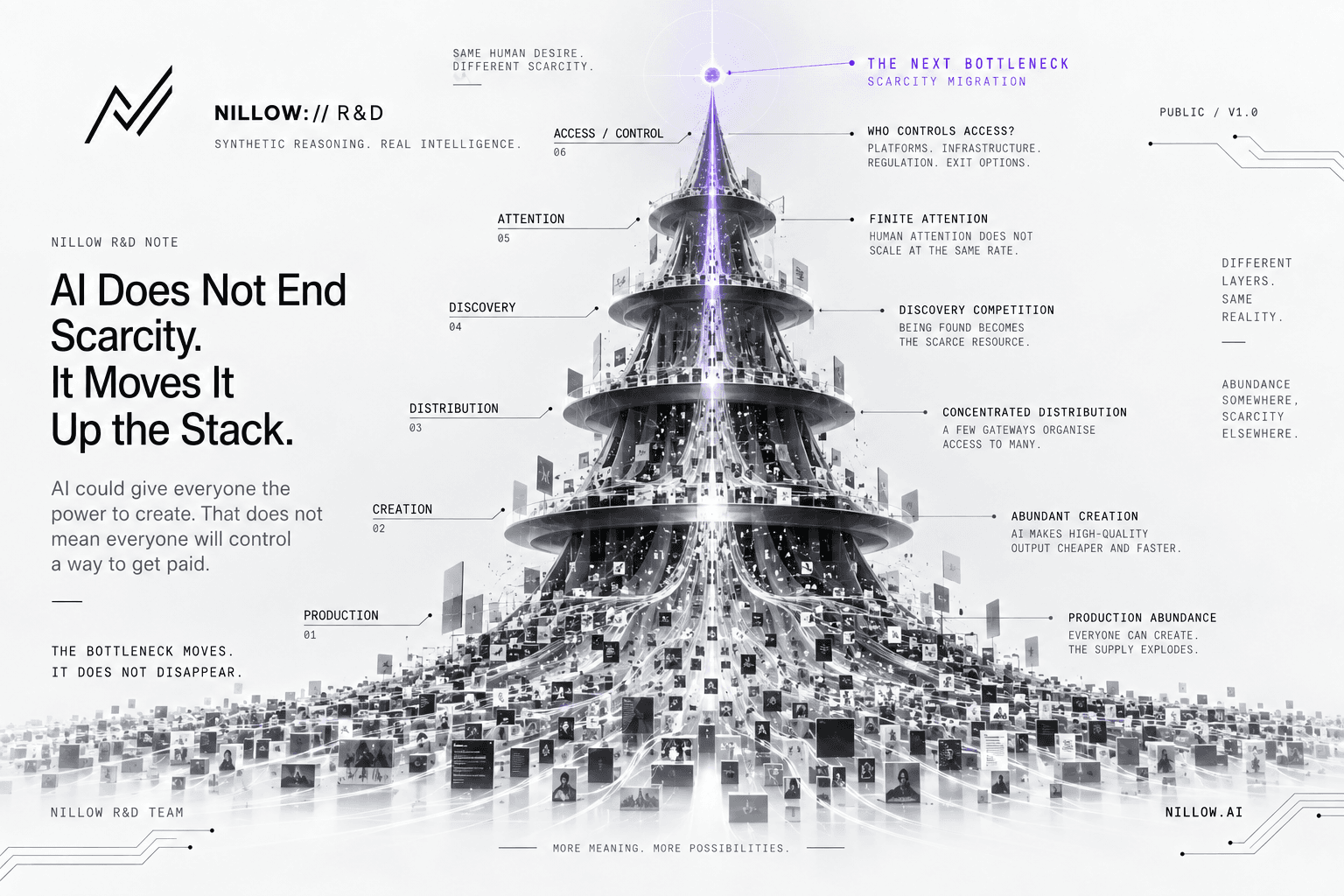
AI Does Not End Scarcity. It Moves It Up the Stack.
AI could give everyone the power to create. That does not mean everyone will control a way to get paid.
- AUTHOR
- Nillow R&D Team
- PUBLISHED
- VERSION
- 1.0
- POSTURE
- PUBLIC · VERSIONED NOTE
AI can make production dramatically more abundant without making attention, infrastructure, distribution or customer access abundant. This perspective traces how scarcity can migrate upward—from creation to discovery, platform dependence and agent-mediated commerce—and argues that durable economic freedom depends on portable relationships, interoperable systems and credible exit.
- Artificial Intelligence
- AI Economics
- Post-Scarcity
- Creator Economy
- Attention Economy
- Platform Economics
- Agentic Commerce
- Digital Distribution
- Economic Autonomy
- Interoperability
- AI Infrastructure
- Future of Work
Imagine opening a studio with no employees.
You direct a small collection of AI agents. They help build the software, produce the visuals, assemble the soundtrack and translate the launch into several languages. A project that once exceeded your budget becomes something you can finish.
You publish.
So do a million other people.
Your ability to create has multiplied. The audience has not multiplied with it.
This is the missing scene in the dream of AI-powered abundance. The tools arrive. Production accelerates. Everyone becomes more capable.
Then the queue forms somewhere else.
The expensive part of the future may not be making something. It may be reaching the people who would value it.
The ladder keeps moving
The familiar advice is to move up the value chain. Let machines handle execution. Humans can concentrate on ideas, judgment and creativity.
Follow that advice far enough and it becomes a theory of civilisation.
Where writing code becomes cheaper, more effort can move into deciding what the software should do. Where coordinating work becomes easier, attention can move toward designing the organisation. Where production becomes abundant, differentiation may depend more on taste, trust, relationships and the experiences people choose to inhabit.
Human work can move into higher abstraction layers: from performing the operation to directing the system that performs it.
But there is no reason to assume that the next layer remains exclusively human. If AI becomes increasingly capable at design, strategy and creative direction, the competition moves again. “Be more creative” is not a permanent economic shelter just because it sounds reassuring.
The deeper question is what happens as the climb continues.
Do people gain control of more powerful systems, or become more dependent on the environments through which they must use them?
Those futures can look identical in a product demonstration.
The creator economy has an attention ceiling
Suppose AI makes excellent films, games, courses and applications much easier to produce.
That would be a genuine expansion of human possibility. Projects abandoned for lack of money could exist. Small audiences could receive work that a conventional production budget would never justify.
But abundance on the supply side does not guarantee an income on the other side.
A viewer can enjoy cheaper entertainment without becoming able to watch everything. A customer can appreciate more choice without buying from every new business. Lower prices can make consumers better off while making some producers’ margins thinner.
In that scenario, the bottleneck shifts from producing something acceptable toward being selected from everything else that is acceptable.
This is already a visible function of platforms. YouTube describes its recommendation system as selecting relevant, satisfying videos using viewing behaviour, feedback and other signals. Uploading a video and having it recommended are separate events.[1]
Now imagine creative output expanding much faster than human attention.
Discovery becomes more consequential. So does the infrastructure that organises discovery.
AI can decentralise production while economic power remains concentrated around distribution.
That is the possibility hiding beneath “everyone becomes a creator.”
You own the film. Who controls its livelihood?
The distinction is subtler than “the platform owns everything.”
YouTube’s terms say creators retain ownership rights in their content while granting the platform a licence.[2] Its monetisation system separately determines eligibility and revenue-sharing conditions. Its partner earnings documentation explicitly offers no guarantee of how much, or whether, a creator will be paid.[3]
Ownership of the work and control over its commercial conditions are different things.
A creator can own a film while depending heavily on someone else’s recommendation system, account access and monetisation programme. Ownership can remain with the creator even when much of the commercial relationship runs through the platform.
You can build a one-person company and still have very little say over the rules that feed it customers.
That arrangement can be enormously useful. Distribution, payments and audience matching are valuable services. The problem is dependence without a workable alternative.
Now extend the example beyond video.
Imagine more livelihoods forming around digital experiences: games, communities, education, simulations, entertainment and personalised services. Automation could make creating those experiences affordable. But the people building them enter environments whose rules they did not write.
The result could be a creator economy with extraordinary expressive freedom and surprisingly limited economic autonomy.
The question is not simply who owns what humanity creates. It is who owns the layer through which creation becomes a livelihood.
Even the customer journey can move up a layer
Agentic commerce makes this more than a question about social-media feeds.
Google and Shopify co-developed the Universal Commerce Protocol, an open standard that enables AI agents to connect and transact with merchants. Google is rolling out UCP-powered purchasing in AI Mode in Search and the Gemini app; participating merchants remain the merchant of record and retain their customer relationships.[4]
That distinction matters. Automated shopping can reduce friction without requiring the seller to surrender the entire relationship.
But consider the next competitive boundary.
A customer delegates the search: find something suitable, compare the options, arrange the purchase. The merchant is no longer competing only for a person’s click. It also needs to be considered by the system assembling that person’s choices.
If a small number of assistants become the default route to demand, influence can concentrate before the customer even encounters a storefront.
Conversely, interoperable agents that users can choose and replace could widen access to customers.
The technology permits both directions. The commercial outcome depends on who controls selection, which providers can participate and how easily people can leave.
The same AI that makes starting a business easier could place another intermediary between that business and its customers.
The stack still plugs into a wall
Higher abstraction does not abolish the lower layers.
A virtual world still needs computing infrastructure. Computing needs electricity, equipment and physical sites. The International Energy Agency identifies grid-connection queues and critical equipment constraints as obstacles to data-centre expansion.[5]
Meanwhile, people still need food, housing, transport and care. A cheaper way to generate entertainment does not make those needs disappear.
So the migration has two directions. Human activity can move upward into designing systems and experiences, while bargaining power gathers around scarce infrastructure below and scarce access above.
The most elaborate digital economy still rests on things that cannot be downloaded.
This is why “post-scarcity” is too blunt a description. Some tasks and products can become dramatically more abundant while other dependencies become more important.
The bottleneck does not have to look futuristic to collect the revenue.
Freedom needs an exit
The meaningful test of an AI-powered economy is not how many people can generate a finished product.
It is how many can turn that capability into durable independence.
Can a business replace its model provider without rebuilding its operation? Can a creator reach willing customers outside one recommendation system? Can a community move without losing the relationships that give it value? Can a merchant change intermediaries without effectively starting again?
Those questions distinguish access to powerful tools from control over the conditions of using them.
Portable relationships, interoperable systems and genuine alternatives matter because they make departure possible. A service does not need to disappear for its users to have leverage. They need somewhere credible to go.
The opportunity is enormous: more people able to build, experiment, organise and earn without needing the permission or resources that once kept them out.
The danger is just as specific: the barrier to creating falls, but the terms of participation remain concentrated elsewhere.
We could become a civilisation of exceptionally capable creators, competing for access to a few privately controlled audiences and environments.
Or abundant intelligence could help people build institutions, businesses and communities they can actually carry with them.
The difference will not be settled by a better model alone.
AI may keep pushing human work up the abstraction stack.
Before celebrating the climb, ask who owns the next floor.
Public references
- YouTube, Recommendations. https://www.youtube.com/howyoutubeworks/recommendations/
- YouTube, Terms of Service, “Rights you Grant.” https://www.youtube.com/static?template=terms
- YouTube, YouTube partner earnings overview and YouTube channel monetization policies. https://support.google.com/youtube/answer/72902?hl=en ; https://support.google.com/youtube/answer/1311392?hl=en
- Shopify Engineering, Building the Universal Commerce Protocol, January 11, 2026; Google, Getting started with Universal Commerce Protocol on Google; Google, New ways to shop and sell with AI, February 11, 2026. https://shopify.engineering/UCP ; https://developers.google.com/merchant/ucp ; https://blog.google/products/ads-commerce/digital-advertising-commerce-2026/
- International Energy Agency, Energy and AI: Executive summary, 2025. https://www.iea.org/reports/energy-and-ai/executive-summary
AI R&D ENGAGEMENT
Have an AI idea that needs to be tested?
Bring the capability you need and the question you cannot yet answer. Nillow designs the experiment, builds the prototype, and tests what holds up.
