Nillow:// R&D note · v1.0
AI Is Liquefying Information. Consulting Was Built on Information Asymmetry.
The next consulting economy will not reward firms that merely know more. It will reward firms that convert liquid knowledge into executable futures.
- AUTHOR
- Nillow R&D Team
- PUBLISHED
- VERSION
- 1.0
- POSTURE
- PUBLIC · VERSIONED NOTE
Consulting historically captured value from scarce knowledge, pattern recognition, executive translation, and confidence under uncertainty. AI is making research, synthesis, comparison, and first-pass strategy easier to produce, compressing the information rent attached to merely knowing more. This research note models the resulting phase shift: value moves toward execution architecture—the workflows, decision rights, governance, data flows, trust structures, and human–AI coordination that make knowledge operational. It introduces information liquidity, information value, execution-architecture value, and future overhang as a public-safe structural lens for understanding why AI does not eliminate consulting asymmetry; it relocates it from knowing to executing.
- AI consulting
- future of consulting
- information asymmetry
- information liquefaction
- execution architecture
- cognition engineering
- enterprise AI
- agentic AI
- workflow redesign
- AI governance
- knowledge work
- future overhang
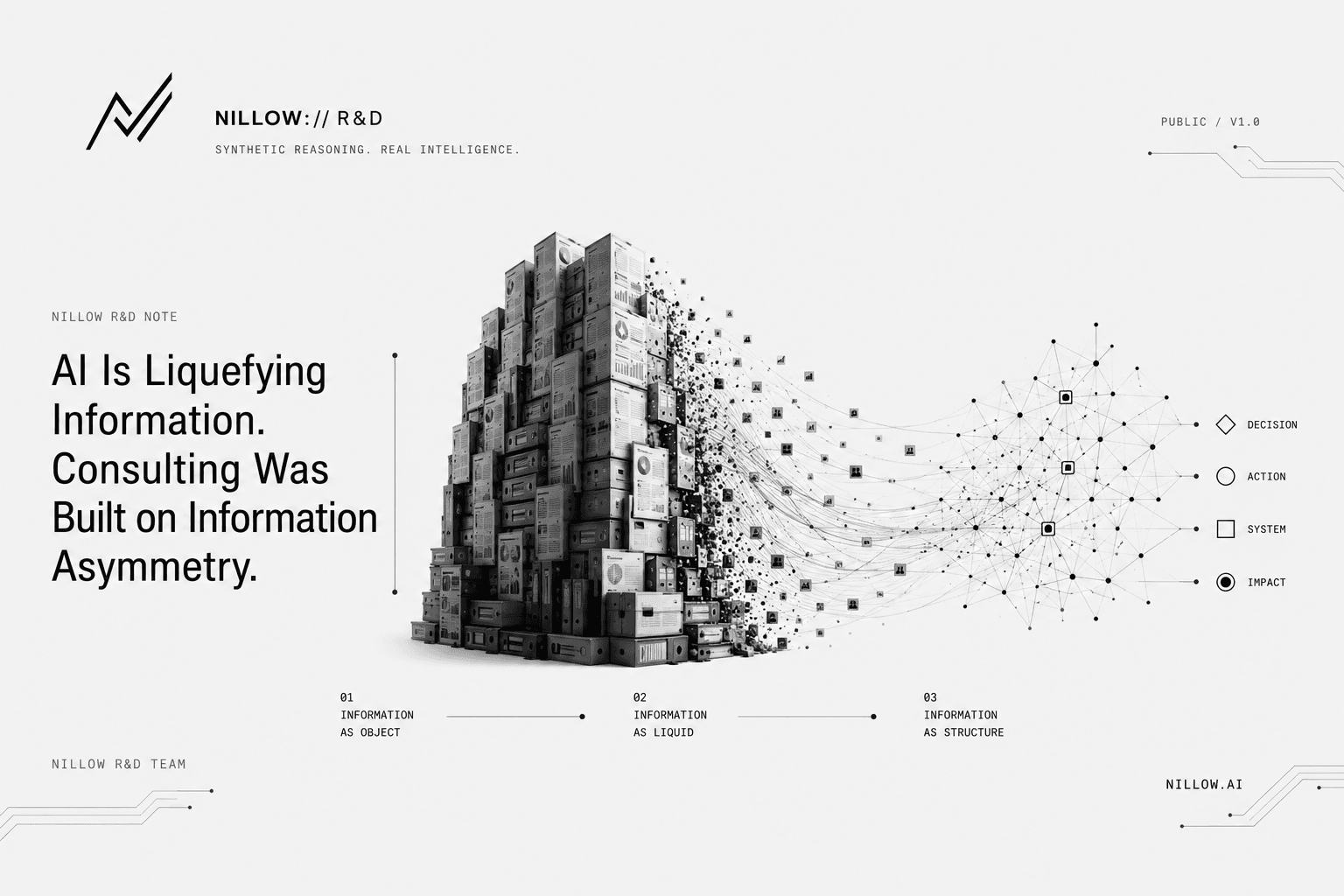
Consulting is not being destroyed by AI. It is being forced to reveal which part of its value came from scarce knowledge, which part came from trust, and which part came from making a future executable.
That distinction matters because consulting was never only advice. At its strongest, consulting compresses uncertainty, translates complexity, routes executive attention, and gives one possible future enough credibility to receive budget, labor, time, and organizational permission.
A company calls a consultant when its internal field cannot yet route itself. Leaders sense pressure, contradiction, opportunity, or decay, but the organization cannot agree on what is happening, which evidence matters, which future is believable, or who should act. Consulting enters that gap with diagnosis, language, benchmarks, pattern recognition, political cover, and implementation memory.
That market was built on information friction. AI is now liquefying information.
It does not make consulting worthless. It makes the old rent unstable.
Consulting was built on information friction
Economies move because participants do not have equal needs, access, time, liquidity, belief, trust, information, or ability to act. Consulting is one professional form built on those differences.
A consultant may know something the client does not. More often, the consultant can organize something the client cannot yet organize: industry evidence, strategic framing, transformation experience, risk language, decision structure, or a common vocabulary that survives a boardroom and a budget cycle.
The work becomes valuable because the client operates inside constraints. Time is limited. Data is scattered. Incentives conflict. Internal politics are noisy. Teams disagree. Leadership needs a course of action that can survive contact with systems, employees, regulation, and the first implementation failure.
Historically, bridging these fields required scarce labor. Research had to be found. Interviews had to be coded. Comparisons had to be assembled. Arguments had to be translated into executive language. The finished deck represented a large compression of human effort.
AI changes the cost of that compression. It lowers the friction between question and synthesis, then between synthesis and a first-pass artifact. The bridge is not free, trustworthy, or complete. But its price is changing fast enough to alter the value gradient beneath consulting.
AI is liquefying information
Information liquefaction is the process by which AI lowers the friction between question, context, synthesis, and action, making specialized knowledge faster, cheaper, and easier to move across roles and organizations.
Liquidity here is not a metaphor for abundance alone. It describes transition freedom. Can scattered material become an intelligible model? Can that model cross from legal to operations without losing its meaning? Can a decision move from a meeting into a workflow before the opportunity closes?
AI raises this form of liquidity by reducing the time required to find, summarize, translate, compare, and package information. A meeting transcript becomes a memo. A memo becomes an action list. A customer complaint becomes a product signal. A legal clause becomes operational risk language. A market report becomes competing scenarios. A scattered internal wiki becomes a searchable decision surface.
The result is not automatically true or safe. Models can be shallow, overconfident, context-poor, or simply wrong. Economic transformation, however, does not require perfect automation. It begins when the cost and speed of a transition change materially.
Before generative AI, a manager might need several days, an analyst, multiple subscriptions, and several interviews to produce a basic market map. Now a plausible first version can appear in minutes.
Not the final version. Not the trusted version. Not the implementation-ready version. But enough to change what a buyer will pay for the first-pass answer.
The first rent to compress is surface knowledge
Information rent is the premium captured by actors who possess scarce access to knowledge, benchmarks, frameworks, expert interpretation, or cross-domain pattern recognition.
Consulting has monetized that rent through research access, benchmark data, reusable frameworks, executive pattern libraries, transformation experience, and talent that can turn ambiguity into analysis. AI compresses the surface layer of this value because clients and consultants both gain substitute access to synthesis.
LexisNexis reports that 56% of management consultants save three to four hours a day through generative AI, while 88% say they understand how writing-oriented large language models work. Those numbers do not prove that consulting expertise has become interchangeable. They do show that the production substrate beneath research, drafting, document analysis, meeting synthesis, and presentation support is changing.
When clients can generate a credible first-pass answer, consultants cannot preserve premium pricing by defending the first pass. Generic market scans, reusable templates, obvious use-case lists, meeting summaries, and slide production become easier to substitute. The client becomes less informationally helpless.
The distinction between surface knowledge and grounded judgment therefore matters. Knowing the standard options is increasingly cheap. Determining which option fits a specific organization, proving the underlying evidence, defining authority, and accepting accountability remain difficult.
AI does not erase expertise. It exposes work that was charging expertise prices for information packaging.
The delivery pyramid changes shape
The classic consulting pyramid placed large amounts of junior labor beneath a smaller layer of synthesis, judgment, and client access. Agentic tools put pressure on that structure because the tasks most available to junior staff—search, classification, drafting, comparison, formatting, and first-pass analysis—are also the tasks easiest to accelerate.
BCG estimates that providers expect a 10% to 20% contraction in the service-delivery pyramid over the next 24 months as agentic AI enters workflows. Yet the same analysis argues that agentic systems could unlock up to $200 billion in net new demand for technology services over five years. Enterprise buyers increasingly want providers to design, deploy, and operate autonomous systems that deliver outcomes.
That is not a contradiction. AI can reduce the labor required for existing deliverables while expanding demand for a different class of work. The pyramid does not simply disappear; it mutates. Information production becomes cheaper, while system integration, governance, evaluation, and operational responsibility become more valuable.
The strategy deck remains useful, but it loses sovereignty. Its surface no longer proves that rare effort occurred. A recommendation that cannot alter a workflow becomes executive theatre, and AI makes theatre cheaper.
The new bottleneck is execution
Most organizations do not lack AI ambition. They lack the ability to turn experiments into stable operating change.
McKinsey's 2025 global survey found that 62% of respondents' organizations were at least experimenting with AI agents, while no more than 10% reported scaling agents in any individual business function. High performers were distinguished not by tool access alone but by workflow redesign, faster scaling, and transformation practices.
Deloitte's 2026 enterprise study found widespread productivity gains but much less structural change: 34% of companies said they were using AI to deeply transform the business, 30% were redesigning key processes around AI, and 37% were still using AI at the surface with little or no change to underlying processes.
PwC's 2026 AI Performance Study describes an even sharper concentration. Twenty percent of organizations captured 74% of the reported economic value from AI. Those leaders were twice as likely to redesign workflows around AI instead of merely adding tools, and 2.8 times as likely to increase decisions made without human intervention while going further on governance.
Different surveys, one structural signal: access is spreading faster than execution capacity.
AI increases the number of futures an organization can imagine, compare, and narrate. It does not automatically increase the number the organization can execute. The difference is future overhang: the gap between futures that have become visible or mobilized and futures that can be safely realized.
Future overhang grows when a company can generate twenty plausible AI initiatives but cannot settle data ownership, workflow authority, exception handling, measurement, security, trust, or adoption for one of them. More options then produce more coordination debt rather than more progress.
That gap is the next consulting market.
The consulting product becomes execution architecture
Execution architecture is the design of workflows, governance, decision rights, data flows, human-AI coordination, and trust structures that convert knowledge into operational change.
This is more demanding than adding a chatbot to an existing process. It asks how information enters the organization, how an AI system interprets and routes it, when a human must intervene, which actions require authority, where evidence is retained, how drift is detected, and what happens after a wrong decision.
It also changes the definition of a deliverable. The consultant does not merely leave a recommendation. The consultant helps create the operating mechanism through which recommendations can be tested, executed, measured, and corrected.
That may involve an AI operating model, a redesigned workflow, a governed agent, a memory structure, an evaluation protocol, or a new boundary between automated and human judgment. Nillow's Cognitive OS is one expression of this shift: the problem is not only generating intelligence, but giving intelligence an inspectable operating environment. The same premise appears in the research note AI Agents Need a Runtime, Not Another Prompt.
The stronger consulting firm therefore sells conversion. It can turn market knowledge into a workflow, a decision structure, governed agents, and measurable change. It connects narrative to permission, information to action, and automation to accountability.
The consultant becomes a cognition engineer
A cognition engineer designs the infrastructure through which humans, AI systems, data, workflows, decisions, and symbolic meaning coordinate.
That role sits beyond prompt writing and generic AI strategy. It concerns meaning-routing systems, decision loops, memory, evaluation, escalation, authority, and the interfaces through which people supervise or collaborate with machines. Nillow's Cognition Engineering practice addresses the custom-built side of this work; the platform side lets organizations compose the operating mechanisms themselves.
In practice, the work can include mapping how a business actually operates, identifying its coordination bottlenecks, redesigning the path from evidence to decision, and building the software that makes the new path real. Hydra represents coordinated multi-agent workflows, while Oxa concerns bounded execution. They are useful here not as buzzwords, but as examples of the layers that appear when intelligence must operate rather than merely speak.
This is where consulting goes when information becomes liquid. The consultant becomes less like a producer of reports and more like an architect of cognition flow.
AI relocates asymmetry from knowing to executing
AI does not end asymmetry. It relocates it.
Old asymmetry: We have research access; you do not.
New asymmetry: We can integrate AI into a messy enterprise workflow without losing authority, traceability, or human judgment; you cannot yet.
Old asymmetry: We know the benchmark; you do not.
New asymmetry: We can turn the benchmark, your data, your incentives, and your operating constraints into a functioning system.
Old asymmetry: We can write the transformation story.
New asymmetry: We can make the transformation story survive reality.
This is why AI consulting will become crowded and remain undersupplied at the same time. AI makes the production of AI advice cheap, so the market will fill with assessments, use-case libraries, readiness scans, prompt workshops, and transformation decks. Serious implementation remains scarce because it still meets context, trust, authority, data mess, incentives, legacy systems, human resistance, regulation, and operational accountability.
Those are not prompt problems. They are execution problems.
A normalized model of the consulting phase shift
The phase shift can be expressed as a structural model. It is a lens for comparing states, not a forecasting engine, valuation formula, causal estimator, or investment tool.
Let identify an organization or engagement and identify time. Every driver below is a dimensionless score on under one frozen measurement contract. The positive coefficients and carry the declared unit of consulting value. Sensitivity coefficients are nonnegative, and is a signed residual in the same value unit. Any empirical use must publish its normalization, reference horizon, weights, and calibration before comparing organizations or periods.
Information liquidity is:
is relevant information availability, is usable participation, is informational depth, and is translation fit across roles and domains. The two terms share one time unit; is the reference time. The geometric mean treats the four liquidity drivers as complements: a severe failure in one cannot be hidden by abundance in another.
The information-value component is:
is surface information asymmetry, is client trust in the adviser, is access to the decision process, is urgency, and is the client's substitute access to AI-assisted synthesis. The separate denominator factors mean information liquidity and AI substitute access can each compress information value independently.
Future overhang is the positive gap between mobilized futures and executable futures, measured on the same basis:
The execution-architecture component is:
is integration need, is the operational importance of the affected decision or flow, is the governance-and-trust requirement, is provider execution capability, and is friction that limits delivery. This distinction resolves the draft model's original sign error: unmet integration and governance needs raise the opportunity for execution architecture, while drag that the provider cannot overcome reduces realized value.
Observed consulting value is then decomposed as:
The residual records value not explained by the two modeled components. Political friction, tacit context loss, unreliable data, adoption lag, governance debt, and omitted variables belong there rather than being forced into an exact identity.
Under positive inputs and coefficients, the directional claims are explicit:
In plain language: holding other factors constant, greater information liquidity and AI substitution compress information value; greater future overhang expands the opportunity for execution architecture; and delivery drag constrains how much of that opportunity becomes real. The total effect of AI on consulting value is indeterminate without estimated magnitudes. That is a feature of an honest model, not a defect to hide.
What clients will buy next
Clients will still buy advice, but the premium will move. They will pay less for generic research, template strategy, reusable frameworks, shallow roadmaps, and obvious AI use-case lists. They will pay more for workflow redesign, governed agent deployment, data and process architecture, decision boundaries, regulated implementation, human-AI coordination, and measurable adoption.
The new buying question is not, “Can you tell us what AI is?” It is, “Can you make this future executable inside our organization?”
The answer requires more than a polished system diagram. It requires a chain from evidence to authority, from authority to action, and from action to an inspectable result. Nillow's broader research ledger examines those boundaries because reliable AI is an architectural problem before it is a branding claim.
Liquid knowledge must become governed motion
AI will make the economy feel saturated with intelligence: more analyses, summaries, options, plans, simulated futures, and tools promising easy transformation.
But liquid knowledge is not transformation.
A future with narrative and no execution becomes theatre. A future with capital and no grounding becomes overhang. A future with action and no trust becomes resistance. A future with AI and no governance becomes fragility. Information that cannot be routed into accountable action remains inert.
Consulting is not dying. The rent attached to surface knowledge is compressing, and the industry is being pushed toward a harder and more valuable layer: execution architecture.
The winners will not be the firms that merely know more. They will be the firms that can turn liquid knowledge into governed motion.
Frequently asked questions
What is information liquefaction?
Information liquefaction is the process by which AI reduces the time and friction between question, context, synthesis, and action, making specialized knowledge easier to move across roles and organizations.
How does AI affect consulting?
AI compresses the value of surface research, drafting, synthesis, and generic strategy production. It increases the potential value of workflow redesign, governance, integration, trust, human-AI coordination, and production deployment.
Will AI replace consultants?
AI will replace or accelerate some consulting tasks, especially research, summarization, drafting, and first-pass analysis. It will also create demand for people who can integrate AI into real operating systems and remain accountable for outcomes.
What is information rent?
Information rent is the premium captured through scarce access to knowledge, benchmarks, frameworks, expert interpretation, or cross-domain pattern recognition.
What is execution architecture?
Execution architecture is the design of workflows, governance, decision rights, data flows, human-AI coordination, and trust structures that convert knowledge into operational change.
What is future overhang?
Future overhang is the gap between futures an organization can imagine or mobilize and futures it can actually execute.
Why do AI pilots fail to scale?
Pilots often fail to scale because organizations have not resolved data readiness, workflow ownership, integration, governance, trust, decision rights, evaluation, and operating-model change. Tool access alone does not solve those constraints.
What is a cognition engineer?
A cognition engineer designs the infrastructure through which humans, AI systems, data, workflows, decisions, and symbolic meaning coordinate.
References
- BCG: The $200 Billion Agentic AI Opportunity for Tech Service Providers
- McKinsey: The State of AI in 2025—Agents, Innovation, and Transformation
- Deloitte: From Ambition to Activation—State of AI in the Enterprise 2026
- PwC: 2026 AI Performance Study
- LexisNexis: The Future of Management Consulting and Generative AI
AI R&D ENGAGEMENT
Have an AI idea that needs to be tested?
Bring the capability you need and the question you cannot yet answer. Nillow designs the experiment, builds the prototype, and tests what holds up.
