Nillow:// R&D note · v1.0
AI for Science: One Human Lifetime Is Not Enough
Why the burden of knowledge—not a lack of ideas—may be the hidden constraint on biotech, nanotechnology, energy, neuromorphic computing and deep-space exploration.
- AUTHOR
- Nillow R&D Team
- PUBLISHED
- VERSION
- 1.0
- POSTURE
- PUBLIC · VERSIONED NOTE
Scientific progress increasingly depends on coordinating expertise across biology, materials, energy, computing and space systems. This NILLOW Research perspective argues that AI's deepest near-term value may be to reduce the burden of knowledge: preserving evidence, assumptions and uncertainty as ideas move between disciplines, software and experiments. It examines Google's Co-Scientist, Intel's neuromorphic research, Berkeley Lab's A-Lab and the risk of scientific monoculture, then proposes a better measure of impact: which research programmes become feasible that otherwise would not.
- AI for scientific discovery
- Burden of knowledge
- Interdisciplinary research
- Biotechnology
- Nanotechnology
- Neuromorphic computing
- Self-driving laboratories
- Energy systems
- Space exploration
- Synthetic language engineering
- Scientific monoculture
- Research infrastructure
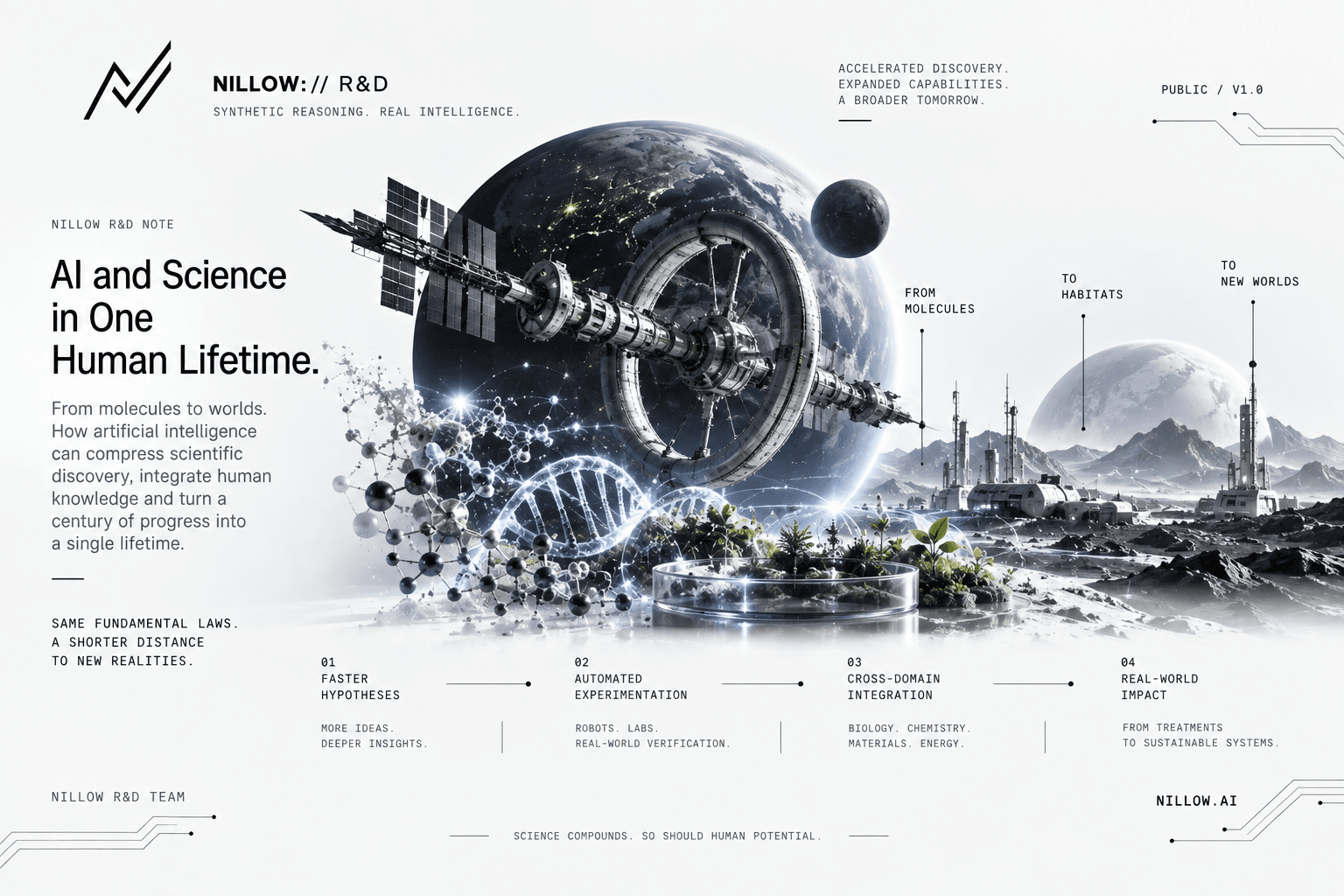
Imagine a spacecraft that can repair its own materials, grow part of its life-support system and navigate situations its designers never anticipated.
It is easy to picture.
Now write the job description.
Understand molecular biology, materials science, radiation, energy storage, autonomous systems and manufacturing. Know where their assumptions conflict. Recognise when a solution in one discipline becomes a disaster in another.
Several lifetimes of experience preferred.
The difficulty is not simply inventing the components. It is making their worlds fit together.
That is where AI's scientific importance becomes more interesting than a machine that reads papers quickly.
It could change which futures civilisation can afford to attempt.
The frontier has an admission fee
Before a scientist can extend a field, they must learn enough of it to recognise where the edge actually is.
Unfortunately, the edge keeps moving.
Economist Benjamin Jones called this the burden of knowledge: as knowledge accumulates, innovators face greater educational demands, narrower specialisation and greater reliance on teams (Jones, 2009). The inheritance grows. The working life does not.
Modern science does not expect one person to understand everything. Laboratories, institutions and collaborations exist precisely because no one does.
But teamwork relocates the burden. Someone still has to connect the findings, translate the assumptions and notice that two specialists are using the same word to describe different things.
A civilisation can possess the ingredients of a breakthrough without possessing an affordable way to assemble them.
This is the frontier behind the frontier: the research that never starts because bringing the knowledge together costs too much.
The difficult industries become interesting again
Consider the territories that dominate our more ambitious pictures of the future.
Biotechnology asks what living systems could be made to do. Nanotechnology asks what becomes possible when structure is engineered at extraordinarily small scales. Advanced energy technologies must turn promising physical effects into systems that survive manufacturing, maintenance and economics.
Neuromorphic computing explores another boundary: borrowing principles from nervous systems to build different kinds of computing hardware. Intel's Loihi 2 research processors, for example, use sparse, event-driven computation and integrated memory and computing to reduce activity and data movement (Intel Labs). Biology becomes an architectural influence on silicon.
Space exploration forces such questions into the same vehicle.
A better material changes the design. The design changes the energy requirement. The energy system changes the thermal problem. Autonomy changes what must be communicated, repaired or decided locally.
These are not independent improvements waiting politely in separate departments.
They interfere.
NILLOW's bet is that these difficult, interconnected domains could become major beneficiaries of cheaper scientific reasoning. Not because AI abolishes their physical constraints, but because it could reduce the cost of navigating their dependencies.
A project rejected as "too complicated to investigate" might become a project worth testing.
That is a larger economic change than completing yesterday's work faster.
Superintelligence is not the starting gun
We do not need to wait for an omniscient machine to make this shift useful.
An AI system could matter enormously while remaining imperfect, provided it helps researchers connect evidence, build analytical tools, compare competing explanations and carry unresolved questions across disciplinary boundaries.
The important capability is not having every answer inside one model. It is making more of civilisation's distributed knowledge usable for a particular problem.
Google's Co-Scientist offers a bounded example. Introduced in 2025 and published in Nature in 2026, the system generated, debated and refined biomedical hypotheses; selected proposals were then examined in laboratory experiments with scientists in the loop. The authors reported experimental support across three biomedical applications (Gottweis et al., 2026). That is meaningful progress, not universal scientific understanding.
The larger possibility is a research process that can sustain combinations no individual could conveniently manage: a biological mechanism, a simulation, a manufacturing constraint and an unexpected measurement, all remaining connected while the investigation changes.
This is where NILLOW's synthetic language engineering enters the argument: designing organisation-specific grammar for humans, models, tools and software so that evidence, uncertainty and authority survive each handoff.
A relationship moving from a scientific paper into software and then into an experiment must retain the conditions that made it meaningful. Uncertainty cannot disappear at the handoff. A correlation cannot acquire the authority of a mechanism because the translation sounds persuasive.
Connecting disciplines is valuable only when the connection survives inspection.
Then reality gets a queue
Imagine that the cost of constructing a credible research proposal falls dramatically.
Better selection could initially reduce wasted experiments. But as more questions become affordable to investigate, demand for physical answers could grow.
Now the scarce resource is instrument time. A clean sample. A reliable assay. A fabrication process. An independent replication.
The machine can propose another candidate immediately.
The furnace is still occupied.
This is why self-driving laboratories belong in the same conversation as AI co-scientists. Berkeley Lab's A-Lab integrates robotics, literature-derived synthesis recipes, machine-learning interpretation and active learning for inorganic materials. When a recipe fails, experimental results can inform what gets tried next (Szymanski et al., 2023).
The bottleneck moves from assembling a question to obtaining an answer from the world.
That movement could reshape industrial priorities. If reasoning becomes cheaper, the organisations that make experimentation reliable and accessible may become more valuable. Laboratories, robotics, measurement systems and manufacturing infrastructure stop looking like supporting equipment. They become the scarce machinery through which abundant intelligence meets reality.
The next great scientific business might not sell better answers.
It might sell the capacity to find out whether an answer is wrong.
A faster monoculture is still a monoculture
There is a darker version of this future.
A laboratory fills with machines generating polished hypotheses from the same literature, using similar models, favouring the same explanations. Output rises. Intellectual range contracts.
Lisa Messeri and Molly Crockett warned in Nature that scientific AI can encourage illusions of understanding and monocultures in which certain methods and questions crowd out alternatives (Messeri and Crockett, 2024).
That would undermine the entire promise.
The objective cannot be an industrial supply of plausible papers. It must be a wider range of credible possibilities, coupled to tests capable of killing the attractive ones.
Otherwise, civilisation has not escaped its cognitive bottleneck. It has automated its preferred blind spots.
Measure the futures that become possible
"Will AI replace scientists?" is an employment question masquerading as the whole scientific question.
Ask something more revealing:
Which research programme became feasible that would otherwise never have been attempted?
Did a small team connect disciplines it could not previously coordinate? Did an overlooked relationship survive an experiment? Did a failed result improve the next investigation rather than disappear into another folder?
Those are the changes that could make biotech, nanotechnology, new computing architectures, energy systems and space exploration a different kind of frontier.
Not guaranteed breakthroughs. A larger territory worth exploring.
The human mind is not becoming less extraordinary. It is carrying an inheritance that no longer fits comfortably inside a human working life.
AI's deepest scientific contribution may be to loosen that constraint, allowing knowledge to remain connected and useful beyond the attention of any one person.
Civilisation should not have to wait for someone to live a thousand years before it can put a thousand years of knowledge to work.
References
-
Benjamin F. Jones, "The Burden of Knowledge and the 'Death of the Renaissance Man': Is Innovation Getting Harder?", The Review of Economic Studies 76(1), 283–317 (2009).
-
Intel Labs, "Neuromorphic Computing and Engineering, Next Wave of AI Capabilities", including the Loihi 2 research overview.
-
Juraj Gottweis et al., "Accelerating scientific discovery with Co-Scientist", Nature 655, 487–496 (2026).
-
Nathan C. Szymanski et al., "An autonomous laboratory for the accelerated synthesis of inorganic materials", Nature 624, 86–91 (2023; corrected 2026).
-
Lisa Messeri and M. J. Crockett, "Artificial intelligence and illusions of understanding in scientific research", Nature 627, 49–58 (2024).
AI R&D ENGAGEMENT
Need an AI research and development team?
Nillow researches, prototypes, and evaluates new AI systems. Bring us the capability you need, the uncertainty blocking it, and the environment where it must work.
