Nillow:// R&D note · v1.0
AI Won’t Just Replace Jobs. It Will Create a New Profession.
Meet the cognition engineer: the profession forming above AI.
- AUTHOR
- Nillow R&D Team
- PUBLISHED
- VERSION
- 1.0
- POSTURE
- PUBLIC · VERSIONED NOTE
AI decomposes jobs into callable cognitive operations. As those operations become cheap and reliable, the economic bottleneck moves from execution to system design: deciding how intelligence is composed, constrained, verified, remembered, authorized, and connected to responsibility. This note argues that the recurring work at that layer is converging into a new profession: cognition engineering.
- Cognition Engineering
- Artificial Intelligence
- Future of Work
- AI Systems
- Human-AI Systems
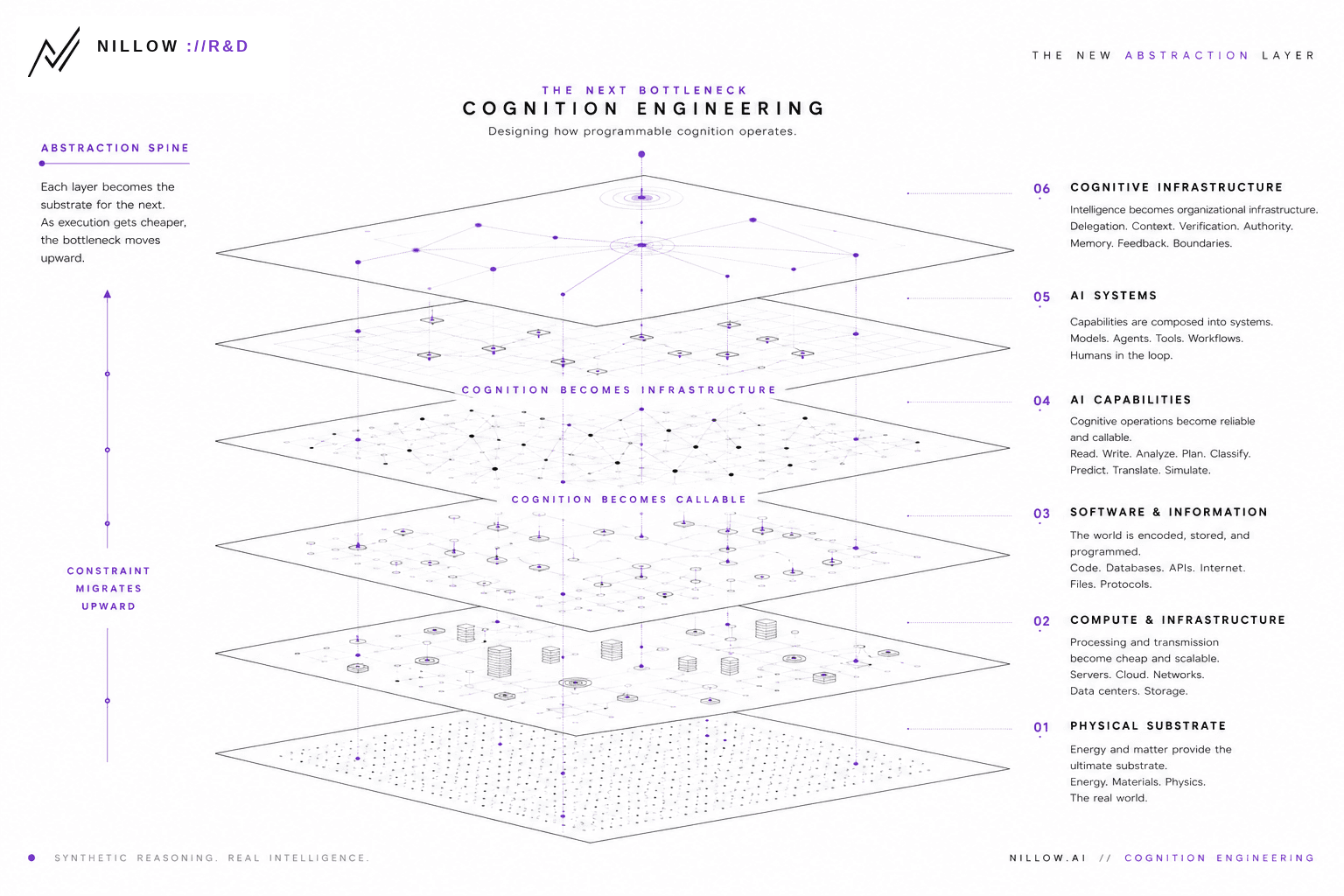
Everyone is asking which jobs AI will destroy. The more interesting question is what profession it will create.
AI will not only automate existing work; it will create a new layer of work above it. Industrial machinery abstracted physical force into systems of production. Software abstracted repeatable procedure into code. AI is now beginning to abstract parts of cognition—reading, writing, classification, translation, planning, analysis, simulation, and coordination—into capabilities that can be called on demand.
When a capability becomes reliable, repeatable, and cheap enough, it begins to behave like infrastructure. Then the bottleneck moves upward. The scarce thing is no longer the operation itself, but the architecture that determines how it is composed, constrained, remembered, verified, authorized, and allowed to act. The profession forming around that bottleneck is the cognition engineer.
Jobs are bundles, not indivisible objects
We speak about “the analyst,” “the developer,” “the manager,” or “the lawyer” as though each job were an atomic unit. In practice, every role is a bundle of transformations. Information enters; someone interprets it, identifies what matters, applies rules, chooses an action, communicates the result, retains context, and carries responsibility for what follows.
AI does not automate that bundle evenly. It decomposes it. An analyst may spend less time collecting and summarizing information but more time defining the question, evaluating evidence, and verifying the thesis. A developer may produce less boilerplate while taking on more responsibility for architecture, permissions, interfaces, tests, and consequences. A manager may generate fewer reports but spend more time coordinating people, models, agents, software, and institutional responsibility.
The first economic effect of AI is therefore not simply the disappearance of professions. It is the separation of cognitive operations from the job titles that used to contain them. Once those operations are separated, they can be delegated, recombined, evaluated, and governed in new ways. The role may survive while its internal structure—and the source of its value—changes completely.
When execution becomes cheap, work moves upward
Every abstraction layer hides lower-level complexity without abolishing it. Software engineers do not place individual transistors, and cloud engineers do not assemble a physical server for every deployment. The lower layer still exists; it simply becomes dependable enough to serve as substrate for the next.
AI is beginning to do this to cognitive labor. Individual operations are becoming callable: a model can read a document, compare claims, propose a plan, generate code, or simulate alternatives; an agent can combine several of those operations and carry a task across tools. But cheap execution is not the same as a useful, trustworthy system. As the operation becomes easier, the difficult question changes from “Can it do the task?” to “How should the task fit into the organization?”
That changes what remains scarce. Value moves from completing every task manually to designing the mechanism that completes it; from producing an answer to deciding what counts as an admissible answer; and from using intelligence to engineering the conditions under which intelligence may act. This is the economic opening for cognition engineering.
A model is not a working cognitive system
The recent AI wave began with model access and moved quickly into integration. Both are still unfolding, but a harder problem is already emerging: organizational reconstruction. Companies are discovering that access to a capable model is not the same thing as possessing a functioning cognitive system.
Consider contract review. A model can summarize a contract, compare clauses, flag unusual language, and draft a response. That does not tell the organization which documents the system may access, which legal standard applies, what must be independently verified, when an exception should escalate to counsel, what the system may remember, or who has authority to accept a change. The generated answer is only one operation inside a larger chain of judgment and responsibility.
A working system needs continuity across time, coordination between different forms of intelligence, and clear boundaries between interpretation and authority. It needs memory, permissions, verification, escalation paths, feedback, and a way to recover when it becomes perfectly coherent inside the wrong assumptions. It also needs an accountable human or institution at the point where an answer becomes a real-world consequence.
Affordable model capability is becoming abundant. Organized, verified, accountable intelligence is not. The model is one component; the architecture around it is becoming the bottleneck.
The profession forming above AI
A cognition engineer works one abstraction layer above individual AI tasks. The role is not simply to prompt a model, automate a workflow, or connect another API. It is to design the infrastructure through which human intent, machine capability, memory, data, tools, permissions, decisions, and feedback become one operational system.
That work overlaps with systems architecture, human factors, knowledge engineering, AI governance, and agent engineering, but its object is distinct: the behavior of the whole cognitive system. Someone must decide how work decomposes; which transformations are delegated and which remain human; which outputs require independent verification; which systems may propose an action but cannot commit it; which information may persist; which agents may coordinate; and which systems may write to reality. They must also decide which contradictions should reopen the process instead of being polished into a confident answer.
The profession will not appear because the technology sector needs another fashionable title. It will appear if organizations continue to encounter the same repeated, expensive, high-consequence bottleneck. At first, the responsibility will often sit inside existing roles: AI architect, agent systems engineer, product lead, governance specialist, or human-AI systems designer. The title may remain unstable for years even as the underlying function converges.
How the transition happens
The transition will not arrive in one dramatic moment. AI first enters existing jobs as a tool. Jobs then decompose into cognitive operations, those operations become callable capabilities, and the capabilities are recomposed into systems containing models, software, tools, memory, agents, and people. When those systems become dependable enough to participate in real organizational action, cognition itself begins to function as infrastructure.
Not every company will hire someone called a cognition engineer, and not every form of work can be reduced to a callable operation. Physical skill, trust, politics, taste, judgment, and legal responsibility do not disappear because a model can generate competent output. But the more organizations rely on programmable cognition, the more valuable the ability to design its boundaries and operating conditions becomes.
The analogy is useful: industrial complexity created a need for industrial engineering, and software infrastructure created a need for software engineering. As cognition becomes programmable infrastructure, it creates a similar need for people who can engineer the system above the model.
AI will compress some roles and eliminate some tasks. It will also raise the ceiling of what one person or organization can coordinate. That creates work concerned with architecture rather than isolated output, orchestration rather than one-off automation, and authority rather than mere capability.
AI will not only change the jobs we have. It will create the profession that designs what work becomes next.
At Nillow R&D, we call this emerging discipline cognition engineering: the design of systems in which human intent, AI capability, software, memory, and authority operate together.
AI R&D ENGAGEMENT
Have an AI idea that needs to be tested?
Bring the capability you need and the question you cannot yet answer. Nillow designs the experiment, builds the prototype, and tests what holds up.
