Nillow:// R&D note · v1.0.0
Nobody Buys From a Robot
Automation is solving production. Nobody is redesigning how people get their share of it.
- AUTHOR
- Nillow R&D Team
- PUBLISHED
- VERSION
- 1.0.0
- POSTURE
- PUBLIC · VERSIONED NOTE
This philosophical essay examines the economic contradiction created when AI and robotics reduce the need for labour while wages remain the main route to purchasing power. It distinguishes production abundance from distribution and participation, revisits the historical case for technological job creation, and surveys basic income, ownership dividends, broad capital ownership, and shorter working weeks as incomplete but relevant alternatives. It does not claim that mass unemployment is inevitable or endorse one policy; it argues that markets still require buyers and that institutions must redesign how people obtain a claim on automated output.
- automation
- artificial intelligence
- future of work
- economics
- economic participation
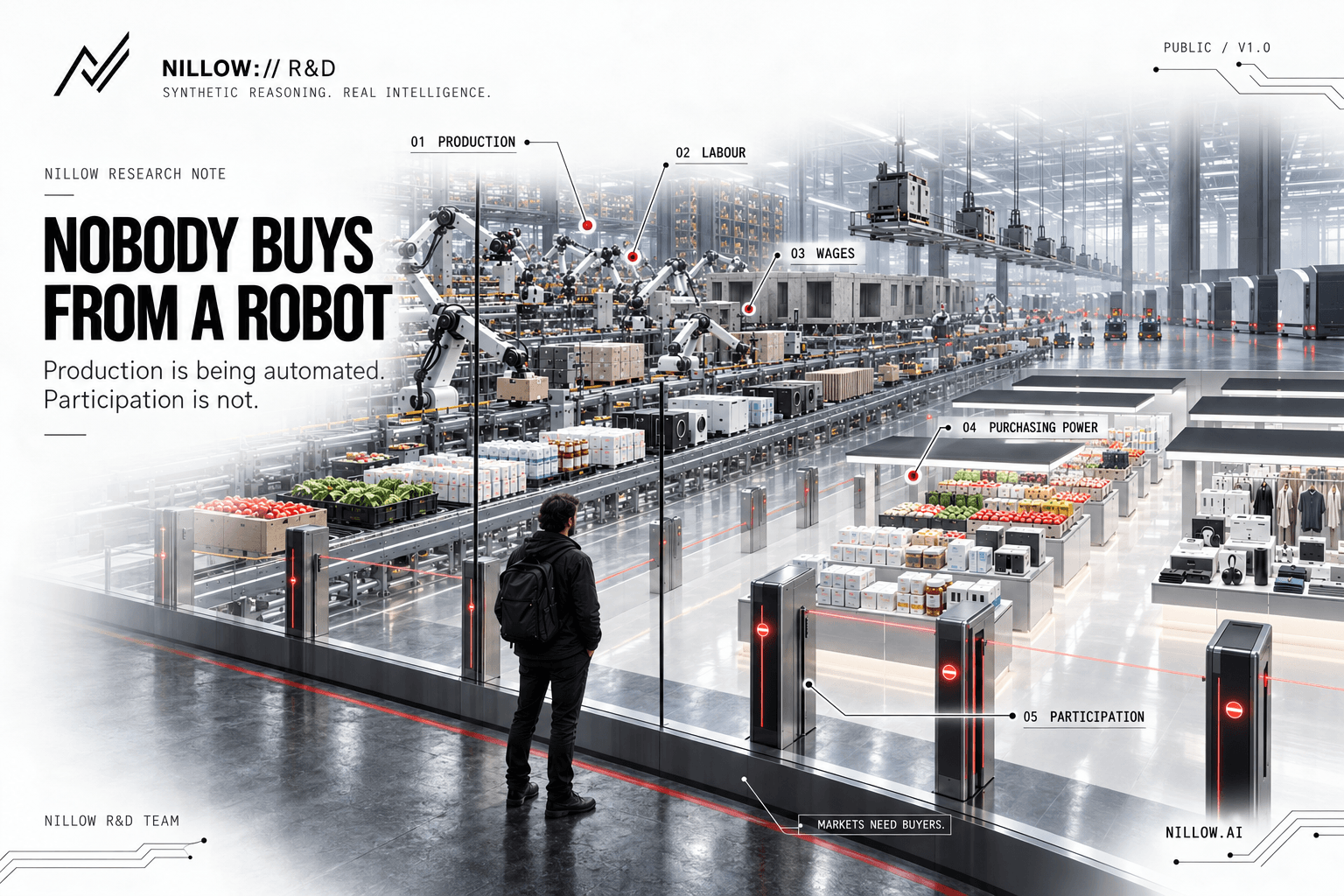
Nobody Buys From a Robot
Automation is solving production. Nobody is redesigning how people get their share of it.
There's a story from a Ford engine plant in the 1950s. It's probably made up, but it keeps getting retold because it's too good.
A manager shows union leader Walter Reuther the new automated machines and asks: "How are you going to get these to pay union dues?"
Reuther answers: "How are you going to get them to buy cars?"
Seventy years later, that's no longer a punchline. It's the question.
Production is getting solved
AI writes code, drafts contracts, reads medical scans, designs parts. Robots assemble, sort, pack and drive.
For a growing list of things, the cost of making them is sliding toward the cost of energy and materials.
By any historical standard, that's the dream every generation before us worked toward.
So why does it feel like a threat?
Because a job was never just a job
We think of work as the way things get made.
But for most people, work is something else. It's the way they get access to what gets made.
You put labour in. You get a wage out. You spend the wage. That loop is the distribution system of the modern economy. It's so normal we don't even see it as a system.
Automation cuts the production side of that loop. But the damage lands on the distribution side.
People still need a place to live, food, transport, healthcare. The need doesn't go away. Their claim on what's produced does.
That's the fear people feel without having the words for it. Not "the machines will take over." Something quieter: I won't have a way in.
"We've heard this before"
Fair. Farming once employed most of the population; now it's a few percent. Looms, tractors, ATMs. Every time, people predicted mass unemployment. Every time, new work appeared.
But look at how that worked. Each wave automated a specific task, and humans moved up to what machines couldn't do: thinking, judging, communicating.
AI goes after that refuge itself.
When the escape route is the thing being automated, "new jobs will appear" stops being a law of economics. It becomes a hope.
And even if new jobs do appear, speed matters. A shift spread over two generations is a career change. The same shift in five years is a crisis.
Not a scarcity problem. A participation problem.
Picture where this leads: an economy that can produce more than ever, while a growing share of people can't buy into it.
Not poor because the goods don't exist. Poor because they have no claim on them.
And here's the part that should worry business, not just workers. Every company wants to cut its labour costs. Every company also needs other companies' workers to have money to spend.
Each firm acting rationally, all of them together sawing off the branch they sit on. That's Reuther's line, scaled up to a whole economy.
So this isn't an argument against markets. Markets need buyers.
We're asking the wrong question
Most debates about AI and work are framed around jobs. How do we retrain people? Protect jobs? Create new ones?
All of those assume employment stays the main pipe through which people get purchasing power.
The better question: what other pipes could there be?
Some ideas already exist:
- Basic income: everyone gets a floor, no conditions.
- Ownership dividends: Alaska already pays every resident a yearly share of its oil revenue. Why not a share of automated output?
- Broad ownership of capital: if machines do the work, people own a piece of the machines.
- Sharing the remaining work: shorter working weeks, so fewer hours spread over more people.
Each has serious problems. None is ready. But at least they aim at the actual problem: not production, but participation.
The real work
We're getting very good at teaching machines to work.
We haven't started teaching our institutions what to do when humans don't have to.
That's the crisis worth being afraid of. It's also the one we can still design our way out of, if we start asking the right question now.
AI R&D ENGAGEMENT
Have an AI idea that needs to be tested?
Bring the capability you need and the question you cannot yet answer. Nillow designs the experiment, builds the prototype, and tests what holds up.
